

Lianfu Food are a company dedicated to supply nutritious plant-based ingredients to our clients across the world. We specialize in the production of premium natural ingredients made from dehydrated vegetables that pet food manufacturers can trust and pets like. Not only dog chew treats, our catalog include freeze dried fruits, nuts, sweet potato chews and other ingredients that are popular in pet treats.
Why Choose Us?
Advanced Equipment
Our production lines are designed in full accordance with international food industry standard. Thanks to such up-to-date equipment and management models, our product quality is guaranteed in an all-round way.
Exquisite Craftsmanship
Our products are minimally processed; The dehydration method used is designed to preserve the nutritional value of each raw, wholesome ingredient as much as possible by removing the moisture without compromising their natural nutrients, enzymes and flavor.
High Strength
We offer a variety of transmission components, including sprockets, roller chains, gears, couplings, racks, hubs, pulleys, taper sleeves, bearing seats, and more.
Professional Service
We offer solution according to your specific requirement. Our online service will respond within 24 hours.
-
![Freeze Dried Okra Whole(dog Chews)]()
Freeze Dried Okra Whole(dog Chews)
Add to Inquiry -
![Dried Vegetables Mix (Dog chews)]()
Dried Vegetables Mix (Dog chews)
Add to Inquiry -
![Freeze Dried Purple Sweet Potato Cube 10*10(Dog chews)]()
Freeze Dried Purple Sweet Potato Cube 10*10(Dog chews)
Add to Inquiry -
![FD Carrot Cube 10*10*3MM]() Add to Inquiry
Add to Inquiry -
![Freeze Dried Okra Whole]() Add to Inquiry
Add to Inquiry -
![Dried Broccoli 3*3]() Add to Inquiry
Add to Inquiry -
![Freeze Dried Pumpkin Cube 10*10]()
Freeze Dried Pumpkin Cube 10*10
Add to Inquiry -
![FD Carrot Cube 10*10MM]() Add to Inquiry
Add to Inquiry -
![Freeze Dried Brussels Sprouts Half]()
Freeze Dried Brussels Sprouts Half
Add to Inquiry -
![Freeze Dried Brussels Sprouts Whole]()
Freeze Dried Brussels Sprouts Whole
Add to Inquiry -
![Freeze Dried Purple Sweet Potato Cube 6*6]()
Freeze Dried Purple Sweet Potato Cube 6*6
Add to Inquiry -
![Freeze Dried Purple Sweet Potato Cube]()
Freeze Dried Purple Sweet Potato Cube
Add to Inquiry







Introduction to Dried Vegetables
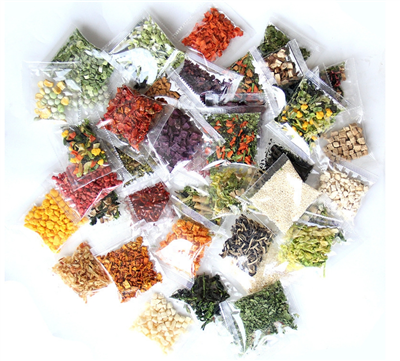
Dried vegetables have become a very popular addition to food storage programs. Dried vegetables can be found commercially in both the dehydrated form and in the freeze dried form. It is also a common food preservation practice to home dry vegetables in either the oven or a dehydrator.
Benefits of Dried Vegetables
Retain More Nutrients
Compared to other food preservation methods, dehydrating vegetables results in only a small loss of nutrients. Removing all the water from the food leaves you with some wonderful intense flavors.
Save More Space
Because a lot of vegetables shrink to a very small size after being dehydrated, which can provide more extra space! Different fruits and vegetables shrink different amounts based on how much water content they have.
Long Shelf Life
Dried fruits and vegetables are expected to last about 5 years under optimal conditions. That's 3 Years longer than canned goods and 4 years longer than frozen food.
Easy To Carry
Dehydrated food is so lightweight it's easy to tote anywhere without the added weight! It can be carried around without the need of refrigeration or ice packs to keep it cool.
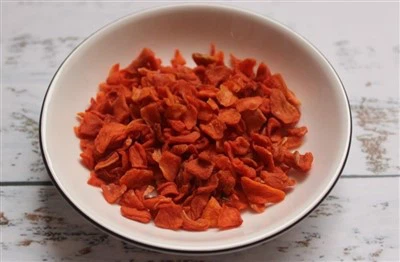
In case of cauliflowers; They are chopped to make small pieces and washed. Then they are blanched and dried in cold air. Spinach leaves are separated from the stalk, washed and dried in the drier. As regards carrots, they are washed, scrapped and cubed after washing. Cubes are then blanched and dried. These dehydrated vegetables are then packed and stored carefully.
Packing is very critical as any fungal growth would damage the product. Process and weight loss varies from vegetable to vegetable but on an average it is 25% as the vegetables are dehydrated. In other words, the input-output ratio is 4:1.

Storage Conditions of Dried Vegetables

Containers of dried vegetables should be stored in a dry, cool, dark place away from furnaces. Low storage temperatures extend the shelf life of dried products. Always store metal cans off the floor, especially bare concrete. Moisture can wick up to cans and encourage rusting.
If there is enough space, dried vegetables can also be stored in the freezer to enhance the shelf life. Foods that are packaged seemingly bone-dry can spoil if moisture is reabsorbed during storage. Check dried foods frequently during storage to see if they are still dry. Glass containers are excellent for storage because any moisture that collects on the inside can be seen easily. Foods affected by moisture, but not spoiled, should be used immediately or re-dried and repackaged. Moldy foods should be discarded.
How Long Will Dried Vegetables Last in Vacuum Sealed Bags?
Various foods have different life spans. Some dehydrated food may last for some days or a couple of weeks. But, these dehydrated food products are unlikely to stay fresh or not get spoiled. After environmental factors like air, moisture, and insects penetrate them.
Now back to how long dehydrated food will last if vacuumed-sealed. Vacuum-sealed dehydrated products can last for up to 10 years. This is because the vacuum seal bag prevents oxygen from entering. Bacteria and mold cannot develop or destroy dehydrated food without oxygen.
Also, the vacuum seal prevents insects from accessing the food. And keeps dehydrated foods from getting wet due to reasons like water splash.
Certificate


FAQ
We're well-known as one of the best dried vegetables manufacturers and suppliers in China. If you're going to wholesale bulk high quality dried vegetables, welcome to get free sample from our factory.
Dried Beetroot,